On the roadMálaga
Long-term car rental for a winter on the Costa del Sol
Nov–Mar
Between November and March the coast fills with people staying three, four or five months, and the car market changes shape for them. What a monthly contract includes that a weekly one does not, where the mileage caps bite, why the price jumps in the last week of March, and the point at which renting stops making sense.

The Costa del Sol has two car markets. One runs from June to September and is about airports, a week at a time, and a queue. The other starts in November and is about people who have taken an apartment in Fuengirola or Torre del Mar until March, and who need a car for a hundred and twenty days.
The second market is quieter, cheaper, and governed by completely different clauses. The seasonal logic is the reverse of everything else on this coast, and the booking window shows it: the pressure is in the shoulder months at each end of winter, not in August.
What changes at twenty-eight days
Most companies treat a month as a different product rather than a long week. The mechanics that change:
- The rate structure. Priced per month, not per day, and typically a small fraction of thirty daily rates.
- The car. You are far more likely to be given a specific vehicle and keep it, rather than whatever comes back that morning.
- Servicing. A car doing four months and several thousand kilometres will reach a service interval. Whose problem that is should be written down.
- The deposit. Usually lower than a summer holiday rental, because the company knows exactly where the car is.
- Insurance. Often a longer-term policy with a different excess. Standalone annual excess cover, if you already hold it, is worth checking against the in-house product because a whole winter of daily excess-reduction charges adds up to real money.
| One week in August | One month in January | Four months, Nov–Mar | |
|---|---|---|---|
| Rate basis | Daily, peak | Monthly, off-peak | Monthly, often discounted again |
| Mileage | Usually unlimited | Capped, commonly 1,500–3,000 km | Capped per month, sometimes pooled |
| Servicing | Not your concern | Possibly your concern | Definitely a clause |
| Deposit | Highest of the year | Moderate | Moderate, held throughout |
| Where you collect | Airport | Airport or town depot | Often delivered to the apartment |
The mileage cap is the line that catches people out. A winter here sounds sedentary and is not: Málaga and back twice a week from Fuengirola is already a few hundred kilometres a month, and one trip to Granada or Seville adds another few hundred in a day. Ask for the cap per month and the charge above it, and if you know you will drive, negotiate the allowance at booking, when it is cheap, rather than at the end, when it is not.
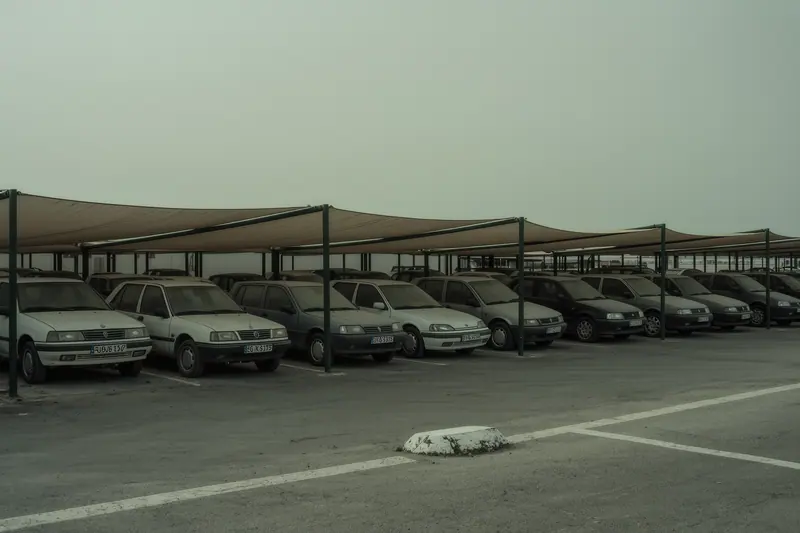
The winter calendar, and the cliff edge in spring
- November. Prices at their softest. Availability is wide and delivery to your address is often free at this point in the season.
- December. A short spike over Christmas and New Year as families arrive, then quiet again.
- January and February. The bottom of the market. Small automatics are the exception — the winter population wants them and there are not many.
- First half of March. Still winter pricing, but the fleet starts being reserved for spring.
- Semana Santa. The cliff. Rates rise sharply and winter contracts frequently stop here rather than roll on.
If your stay runs from November to April, the sensible move is to agree the whole period including Easter at the outset, in one contract. Splitting it and extending in March means renewing into a peak-season rate for the last three weeks, which can cost more than the two months before it.
Automatics, and the other thing the winter market wants
Two requests dominate at this end of the season and both need booking ahead.
Automatic transmission, because a large part of the winter population would rather not change gear on the Málaga ring road, and because the hills behind Mijas and Frigiliana are steep in traffic. Automatics are a minority of a Spanish rental fleet and the first thing to go in the winter months.
A car small enough for coastal parking. The temptation on a long stay is to take something comfortable, and then to spend four months trying to fit it into underground spaces built to a Spanish compact standard. If your apartment comes with an allocated space, get its dimensions before you choose the car.
Where the car will actually go, and where it will not
Two practical constraints for a winter based on the coast.
The first is the toll question. If your daily run is Marbella to Málaga or further, the parallel free and tolled motorways are a real monthly cost decision rather than a one-off — the arithmetic is in the A-7 against the AP-7.
The second is the centre of Málaga. If your winter includes regular trips into the city — a language course, a clinic, a football season ticket — check the emissions label on the car you are given and read the current access rules before you commit to a routine that involves parking inside the old town. The practical answer for most people is one of the large car parks on the edge of the centre, and the reasoning is in driving into the centre.
When renting stops being the answer
Somewhere between five and six months, the arithmetic flips. Buying a cheap second-hand car and selling it in spring can be cheaper on paper, and every bar between Nerja and Estepona has someone who will tell you exactly that.
What they tend to leave out is the transfer of ownership, the insurance as a non-resident, the roadworthiness test if it falls due, and the fact that everybody else is also selling in March. Below half a year, rent. Above it, and only if you come back to the same coast every winter, ask a local gestor what the paperwork really involves before you believe the bar.
And if you are renting the apartment as well as the car, agree the two end dates to match. The most expensive week of a winter stay is the one where the flat has gone back and the car has not.
What to check before you book
- Get the monthly mileage allowance and the per-kilometre charge above it in writing before anything else.
- Ask who pays for servicing, tyres and the roadworthiness test if the car falls due during your months.
- Confirm what happens if you extend by two weeks: monthly rate pro rata, or a fresh short-term rate at short-term prices.
- Check whether the contract covers the whole winter at one price or reprices at Semana Santa.
- Ask whether the car can be swapped mid-term, and what the notice is if it breaks down for more than a day.
- Confirm the deposit is released on return rather than at the end of a later inspection period.
- Check the emissions label on the windscreen if you plan to park inside central Málaga regularly.
Questions people actually ask
- How much cheaper is monthly car rental than daily?
Substantially, and the break usually happens at around three to four weeks rather than gradually. A winter month on the Costa del Sol commonly lands somewhere in the low to mid hundreds of euros for a small car, against a daily rate that would multiply out to several times that. The saving comes from a fleet that would otherwise sit still between November and March, so it is a genuine seasonal discount rather than a volume one.
- What is the difference between long-term rental and a Spanish renting contract?
A long-term rental is the same product as a holiday rental with a longer term and a better rate. A renting agreement is a leasing arrangement, usually a year or more, with maintenance, insurance and road tax bundled in, and it generally requires a Spanish tax number and a credit check. For a four-month winter, the rental is almost always the right product.
- Will I be charged more over Easter?
Very often, yes. Semana Santa is the hard edge of the winter market on this coast, and contracts written at winter rates frequently reprice or simply end before it. If your stay runs into April, agree the Easter weeks at the time of booking rather than assuming the monthly rate continues.
- Is it better to buy a cheap car for a long stay?
Only past about five or six months, and only if you can deal with Spanish registration, transfer of ownership, insurance and the roadworthiness test as a non-resident. Below that the rental wins on cost once you account for the depreciation, the paperwork and the risk of trying to sell in a hurry in March. Ask a local gestor what the transfer actually involves before you decide.