Two wheelsMálaga
E-scooter hire in Málaga and the rules that apply
All year
Powered scooters sit in an awkward category in Spain: not a bicycle, not a moped, and regulated partly nationally and partly by each town hall. What that means for a visitor in Málaga, what shops will actually rent you, where you must not ride, and the alternatives that cause less trouble.

The powered scooter is the most confusing thing you can hire in a Spanish city. It is not a bicycle, so the cycle rules do not automatically apply. It is not a moped, so the licence rules do not either. It sits in a national category called the personal mobility vehicle, with the technical specification set nationally and the question of where you may actually ride left substantially to each town hall.
In Málaga that means the answer to “can I ride here” depends on the street, and occasionally on which year you are asking.
What the national framework fixes, and what it does not
The national side sets the vehicle: a speed ceiling around 25 km/h, a certification requirement, and a firm rule that these are not toys and not pedestrian devices. That part does not change between towns.
Everything spatial is local. Whether you may use a shared pavement lane, whether a promenade is open to you, what the minimum age is, whether a helmet is required and whether liability insurance must be in place — these are municipal decisions in whole or in part, and they have been revised repeatedly in Spanish cities since the vehicles appeared.
The practical rule for a visitor: assume pavements and pedestrian areas are forbidden, assume the seafront promenade is not a road for you, use the marked cycle lanes, and check the current municipal ordinance before you take one out.
| Where | Scooter | Bicycle | Notes |
|---|---|---|---|
| Pavement | No | No | Enforced in the centre |
| Pedestrian streets in the old town | No | Walking pace at best | Larios and the cathedral lanes are packed |
| Marked cycle lane | Generally yes | Yes | The default place to be |
| Seafront promenade | Restricted, check locally | Restricted, slow | Signage varies by municipality |
| Ordinary city road | Depends on the speed limit | Yes | Municipal rule, verify |
| Dual carriageway or tunnel | Never | No | Includes the ring road |
What a shop will actually rent you
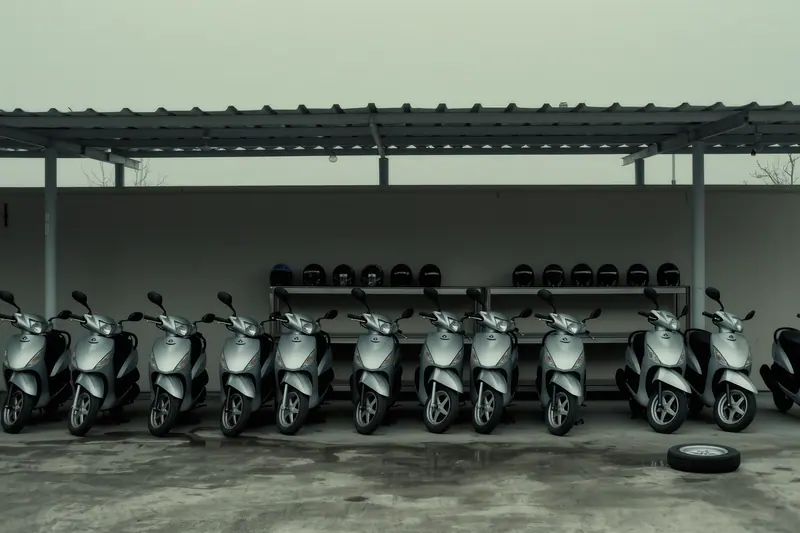
Fixed-premises hire in Málaga is straightforward: you go in, you sign a contract, you get a machine that has been maintained, and you get a phone number if something breaks. Rates run roughly €20–35 a day in high season, less for several days, with a card deposit in the low hundreds.
The clause to read is insurance. Third-party liability is the exposure that matters on a scooter — not damage to the machine, which the deposit covers, but what happens when you clip a pedestrian on a crowded promenade. Ask what cover the rental includes and get it in writing. If the answer is vague, that is an answer.
Shared app-based fleets are a different proposition and an unreliable one. Cities across Spain have licensed, capped, restricted and in some cases removed free-floating operations, and the position in Málaga has not been stable. Do not build a day around finding one on a street corner.
Where a scooter is genuinely useful in this city
Málaga is flat, which is the argument for it. The useful trips are the ones that are slightly too far to walk and annoying by car: the port to the eastern beaches, the centre to the bus and rail station, an office in the northern districts to a meeting in the old town.
The useful trips are also, almost all of them, better on a bicycle. A hired city bike costs less, has somewhere to put a bag, is welcome in more places, and raises no questions about which ordinance applies. The full argument is in the piece on city bike hire and the lanes, and for anything longer than the city itself an e-bike along the coast covers ground a scooter cannot.
Parking it, which is where the fines are
Leaving a scooter across a pavement is an offence and the liability follows the person who left it there, not the shop. In practice: use a bike rack, keep it out of the tactile paving and the doorways, and never leave one in the pedestrian core.
There is a second reason to be careful in the centre. Málaga’s old town is residential above the shopfronts, the streets are narrow enough to funnel sound upwards, and hard plastic wheels on stone at two in the morning carry a remarkable distance. Residents notice. The noise question in the centre is a bigger subject than it looks and is dealt with in the piece on renting a flat in the historic centre.
The honest recommendation
If you want to cover the city and you are here for a few days, hire a bike. If you want to cover the coast, hire an e-bike. Hire a scooter if you specifically want a scooter — it folds, it fits in a boot, it needs no effort in the heat, and in August that last point is not nothing.
Whatever you take, spend two minutes before the first ride checking the current municipal ordinance and asking the shop the insurance question directly. The rules on these vehicles are the fastest-moving traffic rules in Spain, and the person who pays for getting them wrong is the rider.
What to check before you book
- Ask the shop to confirm in writing that the scooter meets the national VMP specification and carries the required certificate.
- Ask whether third-party liability insurance is included and what it covers. This is the clause that matters most and the one shops gloss over.
- Check the minimum age the shop applies and whether it matches the current municipal rule. They are not always the same number.
- Get the helmet included. Requirements vary by municipality and change, and a helmet is sensible regardless of what the rule says today.
- Ask where you may leave it. Blocking a pavement is an offence and the fine lands on the person who parked it.
- Verify the current municipal position with the Ayuntamiento before you ride. Ordinances on scooters change more often than any other traffic rule.
Questions people actually ask
- Can I ride an e-scooter on the pavement in Málaga?
No. Personal mobility vehicles are not permitted on pavements or in pedestrian areas anywhere in Spain, and Málaga enforces this on the seafront promenades. You belong on the cycle lanes and on certain roads with low speed limits. The detail of which roads is municipal, so check the current ordinance rather than following what you see other people doing.
- Are the shared app scooters available in Málaga?
Shared free-floating fleets have appeared, been restricted and been withdrawn in various Spanish cities, and the position in Málaga has changed more than once. Do not plan around finding one. Hiring from a fixed shop for a day is the reliable option and comes with an actual contract, insurance and someone to complain to.
- Do I need a licence or insurance?
A vehicle meeting the national personal mobility specification does not require a driving licence. Insurance is a different question: liability cover for these vehicles has been the subject of national rule changes and many municipalities require it. Ask the shop what cover the rental includes, in writing, and check the current national position before you ride.
- What about renting a moped instead?
A 50 cc or 125 cc scooter is a completely different category with licence, age, helmet and insurance requirements set nationally. It is the better vehicle for actually getting anywhere on this coast, and the worse one for a casual visitor who wants to potter along the seafront. Check what your licence entitles you to ride in Spain before booking.