Two wheelsMálaga
City bike hire and the centre cycle lanes
All year
Málaga has a real cycle network and a historic centre that the network mostly avoids. A hired city bike is the fastest way across the city and a liability inside the old town. Where the lanes run, what a day rate buys, where to leave the bike, and the two junctions that catch everyone.
Málaga is a flat city with a compact centre and about a hundred and fifty kilometres of marked cycle lane, most of it added in the last fifteen years. On paper it should be an easy place to ride. In practice the network is excellent in three or four corridors and abruptly absent everywhere else, and the historic centre — the part visitors most want to reach — is deliberately not part of it.
A hired city bike is the right tool for crossing the city. It is the wrong tool for the last three hundred metres.
The corridors that work
Four routes carry almost all the useful cycling in Málaga.
The seafront runs from Sacaba in the west, through the port, past La Malagueta and out to El Palo. It is flat, wide and continuous, and it is the spine most visitors use.
The Alameda Principal and Paseo del Parque give you an east-west run past the port with a lane separated from traffic for most of its length. This is the route around the old town, and it is the one to default to.
The Guadalmedina corridor follows the river channel north from the centre. The river is dry most of the year and the path beside it is the fastest way from the seafront to the northern districts with almost no junctions.
The western axis out along Avenida de Andalucía towards Teatinos serves the university and the hospitals and is busy with students on weekday mornings.
| Trip | Distance | On the lane network? | Realistic time |
|---|---|---|---|
| Port to Pedregalejo | 5 km | Yes, seafront the whole way | 20 min |
| Centre to Teatinos | 6 km | Mostly | 25 min |
| Centre to the bus and rail station | 1.5 km | Partly, then street | 8 min |
| Seafront to the northern districts | 4 km | Yes, Guadalmedina path | 15 min |
| Anywhere to inside the old town | — | No | Walk it |
The junctions that catch people
Two patterns cause most of the trouble. The first is the lane that ends at a large junction and resumes on the far side with no marked way across; the safe move is to dismount and use the pedestrian crossings rather than improvise in traffic. The second is the shared pavement lane with a bus stop on it, where a queue of people forms directly across the painted strip. Both are worst in the morning.
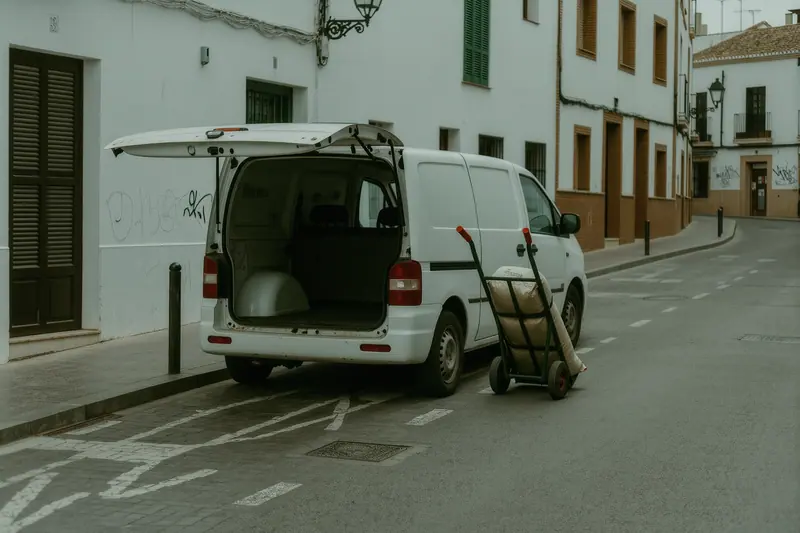
There is a third, less obvious one: the loading bays. Central Málaga runs on deliveries made in a narrow morning window, and a van backing into a bay on a one-way street will occupy the cycle lane entirely while it does so. That is not bad behaviour, it is the only way the shops get stock. Expect it and leave a gap.
What a day rate buys
A plain city bike with three or seven gears, a rack, a basket and a lock is typically €10–18 a day in high season, dropping sharply for three days or more. Shops near the seafront and around the port charge more than shops a few streets inland for the same machine.
What varies is the fit-out. Tourist fleets are often stripped down: no rack, no mudguards, a cable lock and nothing else. If you intend to buy food at the market, carry a laptop to a desk, or ride in the days after a rain shower, ask specifically for a rack and mudguards when you book. They exist, but they are not the default bike the shop hands over.
Deposits are small, usually a card hold in the low hundreds or a photocopy of a document. Decline the photocopy of a passport; a card hold is standard and is what you should insist on.
Locking up, which is where bikes are lost
Theft in the centre is opportunistic rather than organised, and it targets bikes left on the street overnight or locked by the front wheel only. The rules are the usual ones and they work: a solid lock through the frame and rear wheel, to a fixed municipal stand, somewhere overlooked. If the shop supplied a cable lock, treat it as a way of stopping someone wheeling the bike away while you order a coffee, not as security.
Ask what the theft terms are before you take the bike. Many small hire shops carry no theft cover at all and the deposit is not the limit of your liability — the contract may make you responsible for the replacement value. That is a reasonable arrangement, but you should know about it before you leave the bike outside a bar in Pedregalejo for three hours.
When a bike is the wrong choice
Two situations. In the week of the Feria in August the centre and the fairground are both unrideable, the streets are full, and a bike is something you have to mind rather than something that helps. During Semana Santa the processions close different streets each evening and the closures move, which makes any planned route through the centre useless from mid-afternoon.
For everything else, a bike beats the alternatives on distance and cost. If you are working here for a few weeks rather than visiting, the combination of a hired bike and a desk booked by the day covers the city better than any other arrangement, and it costs less than parking a car. For the longer coastal runs east and west, hire something with a motor instead — the reasoning is in the piece on e-bikes and the Senda Litoral.
What to check before you book
- Ask for a bike with a rear rack and a basket if you are shopping. Most tourist fleets are stripped and you cannot carry anything.
- Check the lock supplied. A cable lock is not enough for an unattended bike in the centre, whatever the shop says.
- Test the brakes on the pavement outside before you ride. Hire city bikes get ridden hard and cable brakes go slack fast.
- Ask whether the shop takes the bike back after closing, and where. Sunday evenings are the common gap.
- Confirm what the charge is for a puncture and whether you are expected to fix it yourself.
- Agree in writing where you may leave the bike overnight if you have it for several days.
Questions people actually ask
- Can I ride through the historic centre?
Large parts of the old town are pedestrian, and where cycling is tolerated it is at walking pace among a lot of people. Calle Larios and the lanes around the cathedral are not a route, they are an obstacle. Ride around the centre on the Alameda and the Paseo del Parque and lock up at the edge.
- Is a hired city bike better than the public bike-share scheme?
For a day or two of casual use, a hired bike is simpler: no registration, no docking stations to find, and you keep the same bike. The municipal scheme is cheaper for residents making short repeated trips. Visitors usually find the registration and payment requirements more trouble than the saving.
- Where can I leave the bike safely?
Use a fixed municipal rack, in a busy and overlooked spot, with the frame and rear wheel locked to the stand. Underground car parks in the centre often have a bike area at street level. Avoid leaving anything overnight on the street, and ask the shop whether their insurance covers theft at all.
- Are the lanes any good?
Better than most Spanish cities of this size. The seafront, the Alameda, the Guadalmedina corridor and the routes out to Teatinos and the university are genuinely usable. The weakness is the joins between them, where a lane ends at a junction and leaves you to work it out.